Audio Transcript
Host 1: Okay, picture this: It’s 11:45 PM on a Tuesday.
Host 2: Oh no, I know where this is going.
Host 1: You’re sitting at your kitchen table—you know, the one with the slightly wobbly leg. You are surrounded by a sea of sticky notes, and you have a spreadsheet open that has crashed twice.
Host 2: Spreadsheet. It’s always a spreadsheet.
Host 1: And you are in a very, very heated debate about whether your Aunt Mildred needs to sit next to your cousin who is on some, like, paleo-no-nightshades diet. Welcome to the wedding industrial complex.
Host 2: It sounds like the opening scene of a horror movie, or just a really stressful documentary.
Host 1: It is the stuff of nightmares. And right around that point, one of you looks at the other and just says, “Forget it. Let’s just burn this spreadsheet and go to Hawaii.”
Host 2: That’s the dream, right? The ultimate escape hatch.
Host 1: Totally. You imagine this ocean breeze, no seating charts, no arguments about the salmon versus the beef. Just you, your person, a sunset.
Host 2: It’s a beautiful dream, but here’s the reality check: Getting married on a beach in Oahu isn’t just about buying a plane ticket. You don’t just land and magically get hitched. You’re basically swapping spreadsheet problems for, like, permit problems and tide charts.
Host 1: Exactly. And that is why we are here today. We are stripping away the romance for just a second to look at the machinery of it all. We’re doing a deep dive into how you actually pull off a wedding in Oahu.
Host 2: And we’re looking at it through the lens of one very specific local expert: Reverend James Chun.
Host 1: Yeah, and we’ve got a whole stack of sources here. We’ve got his official service packages, which are hilariously named after fruit.
Host 2: Yes, they are.
Host 1: We’ve got these deep cultural guides on Hawaiian traditions and just a treasure trove of Yelp reviews from 2019 all the way up to 2026.
Host 2: So we’re going to break down the logistics, the costs, the culture. But we have to start with the man himself. Because when I was reading through his bio, I did a—well, I did a double take. On paper, he’s a wedding officiant, but his background is not what you’d expect.
Host 1: Not at all. I mean, he’s been in the Hawaii wedding industry for over two decades. But it’s what he did before that is so fascinating.
Host 2: And what he still does on the side.
Host 1: Right. He has a 15-year background in video production and professional acting.
Host 2: This is my favorite part. The guy has credits in Hawaii Five-O and the new Magnum P.I. Host 1: Now, when I see “actor” on an officiant’s resume, I get a little nervous. I picture someone, like, projecting to the back row, really overacting the “I do’s.”
Host 2: That is a valid fear. You don’t want a monologue; you want a marriage. But if you look at the reviews, this background actually flips the whole thing. It’s not about acting; it’s about having a director’s eye.
Host 1: Right. There was that one review—let me find it—from Patricia S. She called it “the step-aside move.”
Host 2: This is such a huge detail. Okay, so think about a standard wedding photo: The couple goes in for the kiss, and there, looming in the background, is the officiant’s face.
Host 1: Lurker. Nobody wants a lurker in their wedding photo.
Host 2: Precisely. But because James has that video production brain, he understands blocking. He knows where to stand. Patricia said he knew exactly when to step out of the frame so they could have that moment alone, visually.
Host 1: So he anticipates the final shot before it even happens.
Host 2: Exactly. That’s not something you learn in seminary; that is something you learn in an editing room after seeing a thousand ruined shots. It’s a practical skill.
Host 1: It’s super practical. But he also just seems to have this “Renaissance man” vibe. He was born in China, raised in Hawaii, married since ’96.
Host 2: Which is a great credential in this business. It just screams stability.
Host 1: And we have to mention the dogs. He has dogs named Chewie and Solo.
Host 2: A massive Star Wars fan!
Host 1: Which, you know, gives him immediate points in my book. It just humanizes him. You’re hiring a guy who probably has strong opinions on The Mandalorian.
Host 2: But on the professional side, the sources show he’s heavy on credibility. Nominated for Officiant of the Year a couple of times.
Host 1: And he’s on the board of the Oahu Wedding Association.
Host 2: And that matters. Because when you’re hiring someone from, like, 4,000 miles away, you don’t need the coolest guy; you need the guy who knows everyone and shows up. Which brings us to the part where my inner skeptic comes out: the money. The packages.
Host 1: Ah, yes. If you’re planning from, say, Ohio, you need to know what you’re actually buying. And his service packages—I got hungry.
Host 2: They are all fruit-themed. The fruit salad of matrimony. Let’s break down the menu. At the entry level, you have the “Aloha.”
Host 1: The “Aloha” is your no-frills option. It’s $299. You get the ceremony, up to 20 guests, the certificate. It’s the “we just want to be married” package.
Host 2: Simple enough. But then you step up to the “Mango”: $449. So sell me on this—why am I paying an extra 150 bucks for a Mango?
Host 1: This is the most critical tier. This is where people get tripped up. The Mango adds the insurance and the permit.
Host 2: Ah, the boring stuff. Can’t I just—I mean, it’s a public beach. Can’t I just show up and get hitched?
Host 1: Uh, technically no. The State of Hawaii is incredibly strict about this. You need a specific permit. And here’s the kicker: You need a liability insurance policy of $1 million.
Host 2: Whoa. A million dollars just to stand on the sand?
Host 1: For an organized event, yeah. If a ranger walks by and asks for your permit and you don’t have one, they can shut you down instantly.
Host 2: Okay, sold. The Mango buys you off the “illegal wedding list.” Worth it. Then we get fancy with the “Coconut” at $999.
Host 1: This is your social media-ready tier. Adds a 60-minute photo session, 80+ images. I mean, if you’re flying to Oahu, you probably want better evidence than an iPhone selfie.
Host 2: And for basically 500 bucks extra, getting a pro photographer for an hour is a steal.
Host 1: It really is. And finally, the “Big Kahuna”: the “Pineapple.” $1,349. Full service. This includes in-room hair and makeup for the bride. That is a huge logistical headache just gone. They come to you.
Host 2: I love that. But we have to be savvy here. In the sources, there were some—let’s call them specific fees. It’s not always a flat rate, right?
Host 1: Geography is everything on an island. If you’re getting married in Waikiki, fine. But if you want that North Shore sunset, that’s a haul. That’s a $150 travel fee.
Host 2: That makes sense. You’re paying for their gas and time. But there was one fee that made me laugh: the “Sunrise Fee.”
Host 1: Yeah, yeah. If you want to get married before 10 AM, it’s an extra $75.
Host 2: It feels like a tax on morning people.
Host 1: Or a tax on traffic! But honestly, I get it. If I have to be energetic and spiritual at 7 AM, I’m charging extra too. Plus, the beaches are empty. You’re paying for privacy.
Host 2: Totally fair. Okay, so we’ve got the guy, the fruit packages, we’ve paid our morning tax. But what about the actual ceremony? Is it just you stand on the sand, say “I do,” and go get a Mai Tai?
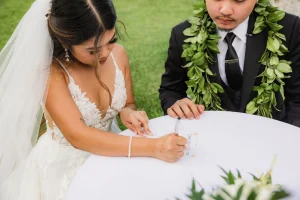
Host 1: No. And this is where the local expert part really shines. It’s about integrating the Mana, the spiritual energy of the islands. These are traditions that go way back.
Host 2: Yeah, let’s unpack a few of these because they’re really beautiful. The first one that stood out was the Oli Aloha.
Host 1: The Oli Aloha is a chant. You have to remember, ancient Hawaii didn’t have a written language. History was kept through chant. So this isn’t just opening remarks; it’s preparing the space, welcoming the couple, asking for blessings. It sets a whole different tone.
Host 2: It grounds you in the place. And then there’s the sound: the conch shell, the Pu.
Host 1: The Pu. It’s that deep, resonant sound. In person, it’s visceral; you feel it in your chest. In a wedding, it announces the marriage, often blown to signal the first kiss.
Host 2: I just keep thinking about the lung capacity required. It’s not a kazoo.
Host 1: It is significant. That’s why you hire a pro. You don’t want to pass out trying to signal your own wedding.
Host 2: And the Lei. I think everyone knows you get a lei, but I didn’t realize there were specifics.
Host 1: It’s very intentional. The bride gets a Pikake lei—that’s jasmine—for romance. The groom gets a Ti leaf lei. The Ti plant is sacred; it represents prosperity, health, protection. And for Oahu specifically, sometimes they’ll use the yellow Ilima flower, the island’s official flower. It’s all very symbolic.
Host 2: The one that really hit me, though, was the hand washing.
Host 1: That’s a powerful one. It feels surprisingly, I don’t know, heavy for a beach wedding. How does it work?
Host 2: Usually before the vows, the couple washes each other’s hands in a bowl of ocean water. The symbolism is about purification. You are washing away the past—past mistakes, past relationships, past hurts.
Host 1: It’s a clean slate.
Host 2: Exactly. It’s a ritual of forgiveness. It acknowledges: “I have a past, you have a past; let’s wash it clean and start now.”
Host 1: That is actually really profound. I feel like we skip that part in modern weddings. We just jump to “I promise to be perfect forever.”
Host 2: Right. This acknowledges imperfection. It says, “We are human, but we are choosing to start fresh.” And then there’s the binding: Pili a Na Ke Aloha.
Host 1: “The love that binds.” They take a Maile lei—the long green vine—and tie the couple’s hands together. It’s the literal island version of “tying the knot.”
Host 2: So you have all these deep, ancient traditions, but then reality hits. We have to talk about the reviews, because if it rains or something goes wrong, you’re in trouble.
Host 1: And this is where the rubber meets the road. A clear pattern emerges from the reviews: crisis management.
Host 2: Oh, the courthouse crisis. This story stressed me out. Kristen S. from July 2025—walk us through it.
Host 1: Okay, so she and her husband fly in. They plan to pick up their marriage license on a Friday at 3:30 PM. But oops, the courthouse closes at 4:00. They miss it.
Host 2: A classic administrative nightmare.
Host 1: So it’s a holiday weekend, it’s Friday night, 8:30 PM. Kristen sends a frantic inquiry to Reverend James. Most vendors would be, I don’t know, at dinner.
Host 2: Or they’d reply on Tuesday.
Host 1: Right. He calls her back in 15 minutes. 15 minutes! On a holiday evening. And he says, “Let’s book a beach wedding.” Five days later, he marries them at Magic Island at sunset. She went from total disaster to a sunset ceremony with family.
Host 2: That is pure responsiveness. That’s a partner, not just a vendor. And then there’s Adrick G. from 2021: the “double surprise.”
Host 1: Oh, the elopement! This is like a sitcom plot. So, Adrick plans a surprise trip for his fiancée’s birthday. Then he finds out his family is quietly flying in to surprise him.
Host 2: So the surprise is blown?
Host 1: So he pivots. He asks his fiancée, “Hey, since we’re there, want to get married?” But they keep the wedding party a secret from the family.
Host 2: So the guests don’t know they’re at a wedding?
Host 1: Not until it starts! So James had to coordinate a “stealth wedding.” Adrick said there was not a dry eye. It shows he can manage the flow of information.
Host 2: And then you have the weather. Jacelynn the First had a story about that.
Host 1: Right. She was pregnant, a storm rolled in. James switched venues with just two days’ notice. That flexibility is key.
Host 2: Right. A local knows: “Hey, the weather’s better on the west side, let’s move.” And one more detail that connects back to that video background: the “unplugged cue.”
Host 1: Oh, this is so smart. He tells the guests, “Put your phones away. Be present.” Which usually lasts about 30 seconds.
Host 2: Exactly. But—and this is the genius part—he promises them a specific moment to take photos later. It’s a bargain. He says, “I promise you’ll get your shot, but for now, let the professional handle it.”
Host 1: So it manages the guests, and the couple doesn’t have to be the bad guy.
Host 2: Yes! So bringing this all together: We started this deep dive talking about the stress of spreadsheets. And what we found in Oahu is—well, it’s a system.
Host 1: It is. You get a guy who, yes, knows camera angles and loves Star Wars, but fundamentally, what you’re buying is reliability.
Host 2: That word “reliability” came up so many times in the sources.
Host 1: It’s the currency of destination weddings. When you’re thousands of miles away, you need someone who knows the Department of Health rules, knows the sunset times, and picks up the phone at 8:30 PM on a holiday.
Host 2: That local knowledge is the difference between disaster and paradise. It really is. You’re hiring a guide, not just a reader. And if we connect this to the bigger picture, I keep thinking about that hand-washing ritual.
Host 1: It sticks with you, doesn’t it?
Host 2: We live in a world of, like, digital noise, where we keep score. And I have to wonder, in this modern high-tech world, is it possible that the most necessary part of a wedding is that ancient act of washing away the past?
Host 1: I think so. Forgiveness is the foundation. We focus so much on the party, but the ritual of saying, “I forgive you for who you were, and I love who you are becoming”—I mean, that’s what makes a marriage work.
Host 2: I might go wash my hands right now just to feel a little fresher.
Host 1: Couldn’t hurt. Well, if you are planning a wedding or just, you know, dreaming of escaping your spreadsheets, we hope this deep dive gave you a little taste of Aloha.
Host 2: And hey, if you want more insights on how to navigate weddings in Hawaii, make sure you subscribe to this podcast.
Host 1: We’ve got more deep dives coming up!
Host 2: Mahalo for listening, everyone!