Audio Transcript
Host 1: Okay, picture this. You close your eyes, you’re imagining the ultimate wedding. I’m talking the universal dream here. Toes in the sand, a gentle ukulele strumming somewhere…
Host 2: Mm-hmm.
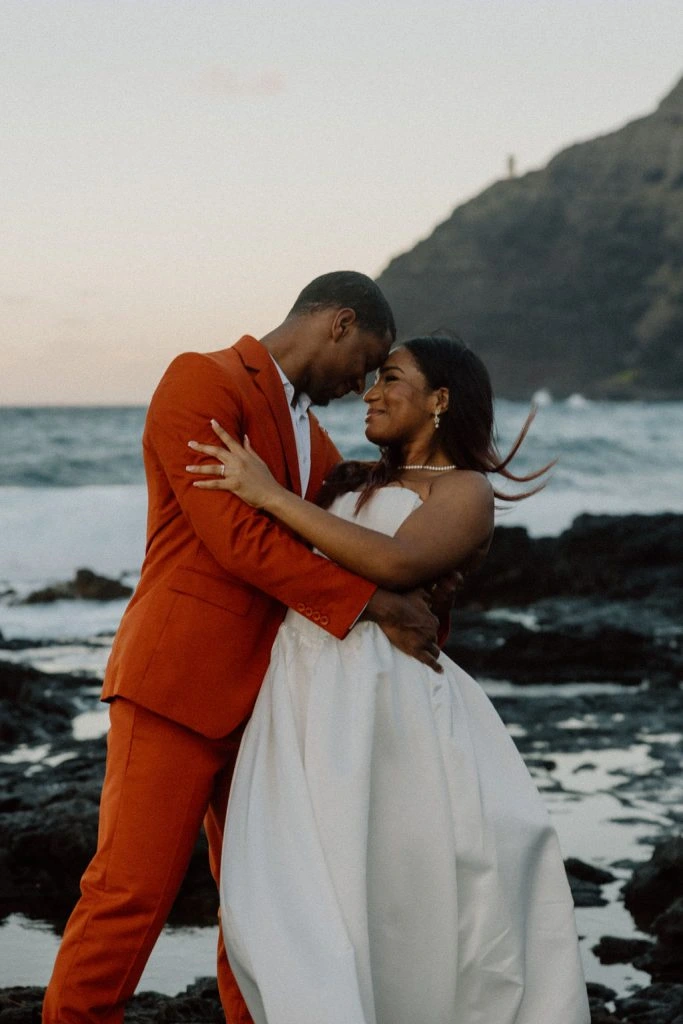
Host 1: …the sun dipping below the horizon in this blaze of orange fire.
Host 2: Oh yeah.
Host 1: It’s perfect, right? It is the desktop wallpaper of your life.
Host 2: It is the archetype. I mean, it’s the absolute pinnacle of the whole romantic wedding industrial complex. The Hawaii dream.
Host 1: Exactly. But then, you know, you open your eyes.
Host 2: And reality hits.
Host 1: Reality hits you like a wet towel. You realize that paradise also comes with logistics. It comes with these sudden, torrential downpours that are definitely not on your weather app.
Host 2: Right.
Host 1: It comes with humidity that does unspeakable things to hairspray. And, oh yeah, about 10,000 tourists in speedos standing right behind your altar taking selfies.
Host 2: That is the classic tension, isn’t it? It’s the Instagram photo versus the, you know, the logistical nightmare.
Host 1: Yeah. And that’s exactly what we’re unpacking today. We are taking the guesswork out of getting hitched in Hawaii.
Host 2: Right. Because we’ve got this whole stack of sources here. We’re looking at the website, blog posts, and a massive slew of reviews for a Reverend James Chun. He’s apparently the guy to know. Goes by the “Hawaii Wedding Minister.”
Host 1: Yeah. What I really appreciate about this deep dive is that we are moving past the glossy brochures. The sources we have, specifically this one very honest blog post on his site about the best time to get married…
Host 2: Mm-hmm.
Host 1: …it reveals that, you know, while everyone just assumes Hawaii’s 85 degrees and sunny 365…
Host 2: They think it’s a constant.
Host 1: It’s way more nuanced than that. So much nuance. We’re going to talk about how to avoid what I’m calling the “Soggy Bride syndrome…”
Host 2: And the “Sweaty Groom syndrome.”
Host 1: Oh yes. Because nobody wants to look like they just ran a marathon in a tuxedo. But before we get into the meteorology and sweat management, let’s talk about the man himself.
Host 2: Mm-hmm. Who is this Reverend James?
Host 1: It’s an interesting place to start because, in the wedding industry, the officiant is often the last thing people book. You get the venue, the photographer, the dress…
Host 2: Mm-hmm.
Host 1: …and then you’re like, “Oh right, we need someone to actually marry us.”
Host 2: The legal part. It’s kind of important.
Host 1: Exactly. But looking at his “About” page, Reverend James Chun has this very specific persona that seems, I don’t know, designed to counter that last-minute panic.
Host 2: Okay.
Host 1: The text describes him as calm, sensible, and warm.
Host 2: Which, let’s be honest, are the three adjectives you desperately need when your flower girl is crying, the ring bearer is eating sand, and your mother-in-law is complaining about the heat.
Host 1: Precisely. You don’t want high energy in that moment; you want an anchor. But there’s a detail in his background that I found… well, fascinating. It’s what I’d call his secret weapon.
Host 2: Oh?
Host 1: Before he became an officiant, he spent over 20 years in the wedding industry owning a video production company.
Host 2: Wait, he was a videographer? Like, professionally?
Host 1: He was. And if you think about the implications of that for a second, it’s actually huge for the couple.
Host 2: I mean, I see the connection, but break it down for me. Why does a guy who held a camera make for a better minister?
Host 1: Well, think about what a videographer cares about.
Host 2: Okay.
Host 1: They care about sightlines, they care about audio, they care about flow. A videographer knows exactly where to stand so they aren’t blocking the couple’s first kiss.
Host 2: Oh, that is such a good point. We’ve all seen those wedding photos where the officiant is just looming right over the couple’s shoulder like a ghost.
Host 1: Or they’re standing dead center during the kiss.
Host 2: No, hate that.
Host 1: Exactly. The source material explicitly says he understands flow, timing, and presentation. Because he’s spent decades looking at weddings through a lens, he’s basically directing the scene to make sure it looks good for everyone.
Host 2: That’s incredible.
Host 1: He knows that if he stands six inches to the left, the lighting hits the bride better. That is a technical skill set that, you know, most standard ministers just don’t have.
Host 2: That is a total pro move. It’s like hiring a director who also happens to have the legal authority to marry you.
Host 1: Pretty much. And he’s got the local cred to back it up, too, right? He’s not just some transplant who moved there last year.
Host 2: Far from it. He was born in China but was raised in Hawaii since he was five. So he embodies that Aloha spirit. And, you know, in the sources, that’s not just a marketing buzzword. It’s presented as a real cultural value of warmth.
Host 1: Okay.
Host 2: But he balances that with this high level of professionalism. He’s an ambassador for the Hawaii Chamber of Commerce and a board member of the Oahu Wedding Association.
Host 1: So he’s a serious guy. He’s plugged into the local business community. He’s not just, you know, a guy with a certificate from the internet.
Host 2: He is respected. But—and here is where it gets fun—he’s not too serious.
Host 1: Oh?
Host 2: I was looking through his bio just to get a sense of the person, and it mentions he’s been married to his wife since 1996, so, you know, he believes in the product he’s selling.
Host 1: Always a good sign.
Host 2: But then, it lists his dogs.
Host 1: Oh, I saw this! Please tell me we can talk about the dogs.
Host 2: We have to. He has two dogs; their names are Chewie and Solo.
Host 1: Star Wars dogs! Yes!
Host 2: Star Wars dogs. It’s such a small detail, but it does so much heavy lifting. You know, it humanizes him immediately.
Host 1: Yeah. It tells you there’s a personality beneath the robes. You’re not just hiring a reverend; you’re hiring a guy who probably appreciates a good sci-fi reference and isn’t going to be, like, stiff and boring.
Host 2: I love that. It just signals that he can probably handle a joke or a slightly unconventional vow. Takes the pressure off.
Host 1: For sure. Okay, so we know the guy is cool, he knows camera angles, and he likes Wookiees. Now let’s get into the meat and potatoes of this deep dive: the weather.
Host 2: The weather.
Host 1: This is where dreams go to die if you aren’t careful.
Host 2: I feel like there’s this massive myth that Hawaii is just perfect all the time. Like it’s a controlled terrarium where someone just set the thermostat to 78 and broke the knob.
Host 1: That is the prevailing myth. And the blog post on his site—the one called “Best Time to Get Married in Hawaii”—it tackles this head-on. The author admits that, yeah, technically, temperatures do stay between 75 and 95 degrees year-round.
Host 2: Which sounds perfect to me. I’m freezing right now.
Host 1: On paper, yes. But as the source says, the devil’s in the details. Hawaii has microclimates. It has trade winds. It has all these seasonal shifts that can drastically change the vibe of your wedding.
Host 2: Right.
Host 1: It’s not just “Is it sunny?” It’s “Is it humid? Is it crowded? Are there whales?”
Host 2: Whales are a valid weather condition in Hawaii, apparently. Okay, let’s break it down season by season, because I think most people just pick a date based on when they can get off work.
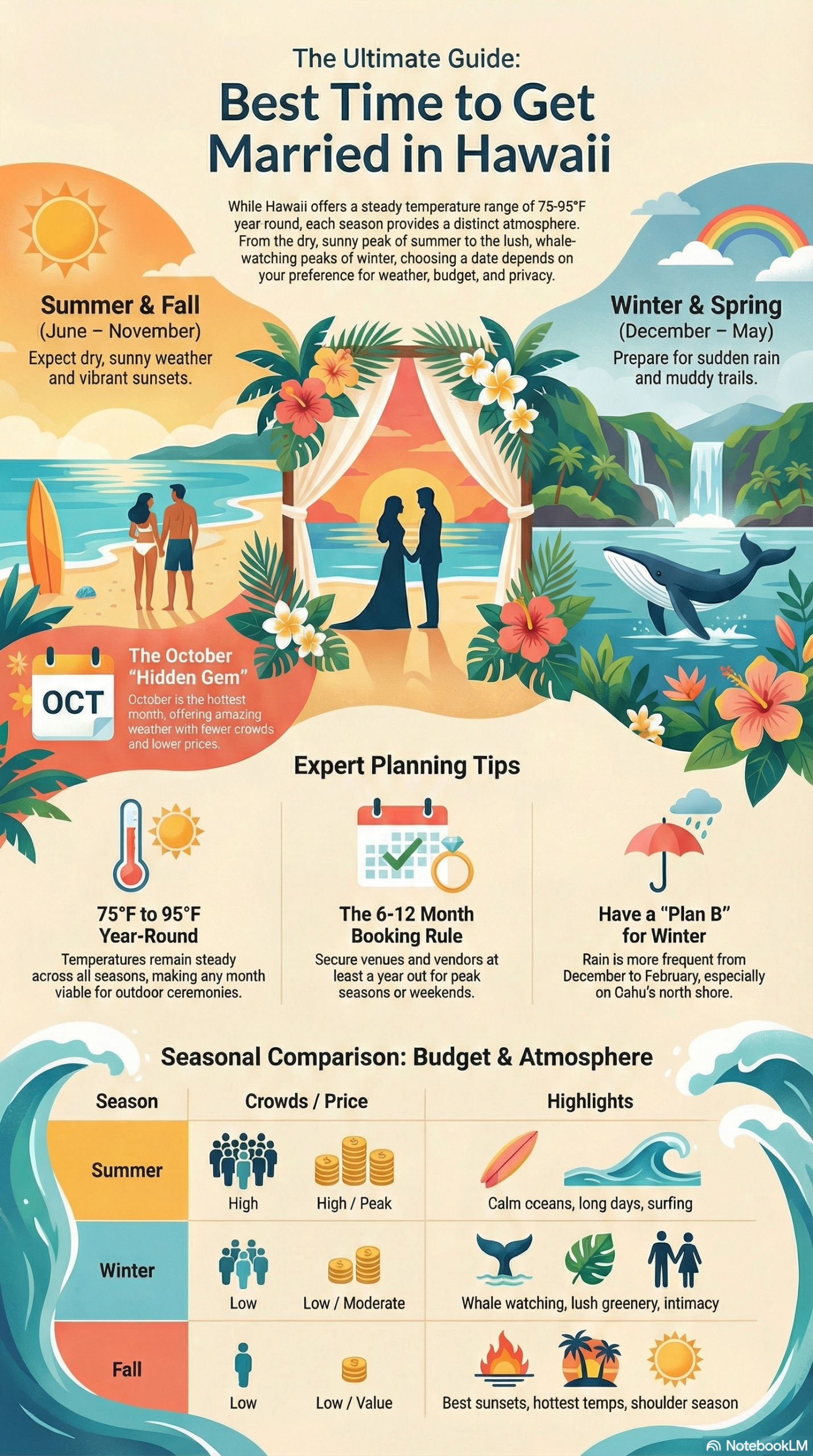
Host 1: That’s right. Let’s start with summer: June through August. This is the default, right?
Host 2: Correct. It’s the most popular season. The blog highlights the pros: it’s warm, it’s reliably dry, the ocean is that postcard blue, and the days are really long. You get maximum sunlight.
Host 1: The classic beach ceremony.
Host 2: Exactly. If you want that toes-in-the-sand vibe, this is your prime window.
Host 1: And I saw a note about surfing.
Host 2: Yes. If the couple surfs, the source notes this is the best time for the South Shore swell. So you can get married and then go catch a wave. It’s a very specific lifestyle appeal. “I do” and paddle out.
Host 1: However… I sense a “but” coming. A big, tourist-shaped “but.”
Host 2: There is a significant downside.
Host 1: I can guess. Kids?
Host 2: Everyone. It is peak tourist season. Schools are out, families are on vacation. The source warns that the islands get pretty crowded.
Host 1: And that’s not just people in your photos.
Host 2: No, we’re talking basic economics. With crowds come price spikes.
Host 1: Supply and demand.
Host 2: Exactly. Hotels, venues, dinner spots—everything is more expensive and harder to book. You’re competing with every single family from the mainland who decided to take a summer trip.
Host 1: You’re paying a premium to stand in line.
Host 2: Basically. So the verdict on summer is: great if you have the budget and you don’t mind an audience of strangers in floral shirts, but maybe not if you want, like, seclusion.
Host 1: Precisely. If you like a lively atmosphere, go for it. If you want intimacy, it’s tough. Now let’s look at the opposite: winter, December through February.
Host 2: Okay, coming from the mainland, winter usually means snow and misery. But in Hawaii…
Host 1: It’s definitely not freezing, but here’s the plot twist.
Host 2: Yeah?
Host 1: It is rainy. The source specifically points out that Oahu’s North Shore gets quite soggy during these months.
Host 2: “Soggy” is really not a word I want associated with my wedding gown. Or my hair. “Here comes the Soggy Bride.” No thanks.
Host 1: Right. You have to be mentally prepared for showers. But there is a cool factor, literally. The temps are lower, which could be much more comfortable for a full suit or a heavy dress.
Host 2: You’re not melting.
Host 1: You’re not melting. And the landscape is incredibly lush and vibrant green because of all that rain. Plus, fewer tourists. But wait, there’s an ace in the hole for winter, right? The source mentions something massive that might make the rain worth it.
Host 2: The whales!
Host 1: The whales. I feel like this is a game-changer.
Host 2: It is whale-watching season. The source actually suggests imagining tying the knot with humpback whales breaching in the background.
Host 1: Can you imagine? “I take thee, Rachel”—splash—giant whale tail in the background.
Host 2: I know. That is a photo you cannot get in July, no matter how much you pay. That’s National Geographic stuff.
Host 1: It’s a high-risk, high-reward strategy. You risk the rain, but you might get a whale. And the source adds a pro tip for winter: sunrise weddings.
Host 2: Sunrise? That sounds painful. I am not a morning person.
Host 1: It is early. The sun comes up around 7:00 or 7:30. But think about it. The lighting is that soft, golden hour glow. It’s not too hot yet. And, crucially, you beat the crowds. You might actually have the beach to yourself.
Host 2: I’m kind of sold on the whale gamble, honestly. But yeah, you have to be a morning person. Okay, what about spring? March to May.
Host 1: Spring is a mix. You get colorful blooms, mild temps… sounds lovely. But the source gives a very specific reality check about waterfall shots.
Host 2: Oh, because everyone wants that “Jurassic Park” waterfall vibe. “Look at us, we’re adventurers in love.”
Host 1: Right. But here’s the thing about waterfalls: they need water. And in spring, especially April and May, the rain makes the waterfalls flow beautifully. But rain also means mud. The source warns about muddy trails and mosquitoes.
Host 2: Ah, nothing says romance like swatting a mosquito off your fiancé’s nose during the vows.
Host 1: Or slipping in mud in your heels.
Host 2: Right. It’s a logistical hazard. However, the source does note that March is a sweet spot for last-minute deals before the big rush starts. So if you’re looking to save money, late winter or early spring is a strategic choice.
Host 1: Okay, moving to fall: September, October, November. This is usually my favorite time of year. Flannels, pumpkins…
Host 2: Prepare to be surprised. According to the source, October is actually the hottest month in Hawaii.
Host 1: Wait, really? October? That just feels wrong.
Host 2: It’s because the trade winds die down. It doesn’t start cooling off until December. So if you book an October wedding thinking you’ll get a crisp autumn breeze, you are going to be sweating.
Host 1: That is a crucial piece of intel. I feel like that catches so many people off guard. You plan for fall vibes and you get a heatwave.
Host 2: But it is considered the “shoulder season.” The summer crowds leave, prices drop, and this is a key visual detail from the blog: the sunsets are described as vibrant pink and orange.
Host 1: Ooh. So the Instagram filter comes built-in.
Host 2: Exactly. But there’s a warning: November starts the rain cycle again. So early fall is the target if you want those colors.
Host 1: Got it. So October for heat and insane sunsets, November for rain. That is wildly helpful. I feel like we just saved a dozen couples from heatstroke.
Host 2: That’s the goal. Knowledge is power, especially when it concerns humidity.
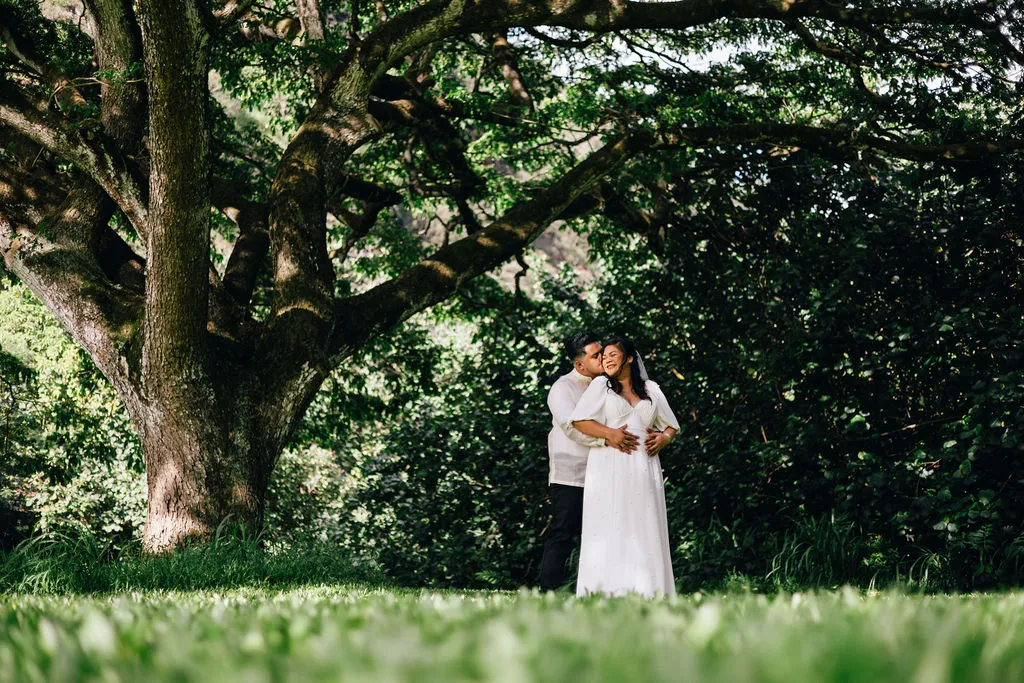
Host 1: Now let’s talk about where this is all happening. Because when I look at the source images on the website, it’s not just beaches. I’m looking at one photo here—it’s this couple under a massive, massive tree. It looks like a forest.
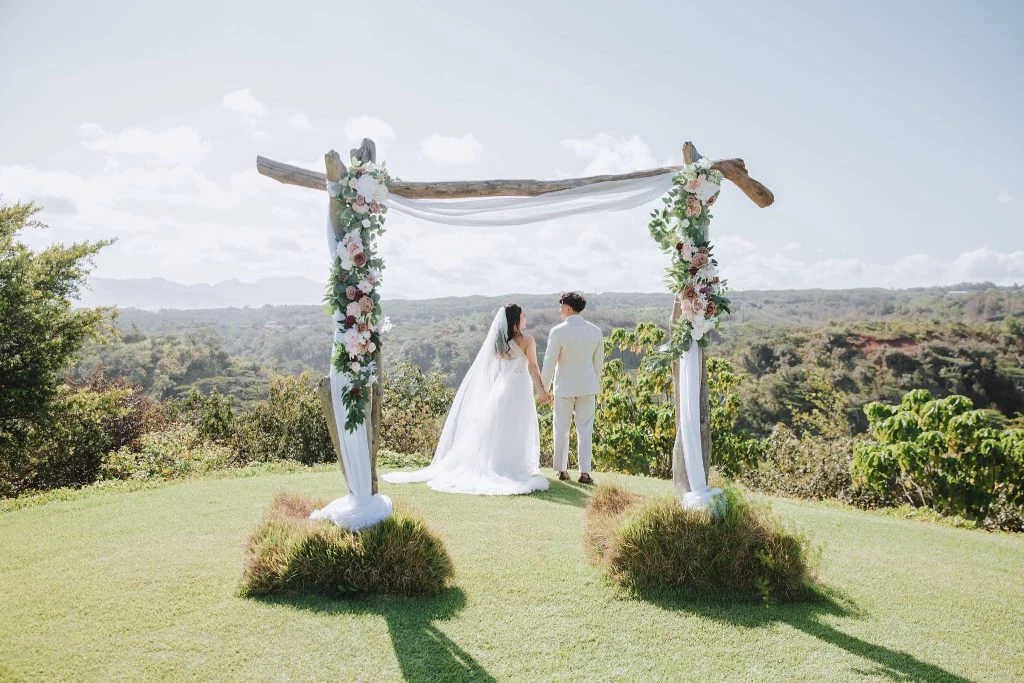
Host 2: Yes, that image is striking. It signals that Reverend Chun isn’t limited to the shoreline. That tree gives off a very grounded, sort of ancient vibe. And there’s another image of a wooden arch on a grassy hill overlooking a valley.
Host 1: Right, it looks like they’re on a cliff or a hillside. Very “upcountry” vibes.
Host 2: So the takeaway is: Oahu isn’t one-note. It’s cliffs, forests, and beaches. You have options. You don’t have to get sand in your shoes if you don’t want to.
Host 1: And this versatility is reflected in the reviews, which is our next data set. We have reviews from couples like Joanne, Breonna, and Corey G. And if you analyze the language they use, patterns start to emerge.
Host 2: What’s the pattern? Is it just “He was nice”? Because “nice” is the bare minimum.
Host 1: It’s more specific than that. The phrase “great price” appears repeatedly.
Host 2: Always good to hear. But usually, in the wedding industry, “cheap” means “sketchy” or “hard to get a hold of” or “you’re getting married in a drive-through.”
Host 1: Right. That’s the anomaly here. The value proposition is high. The reviews couple “great price” with terms like “prompt” and “communicative.”
Host 2: Again, that professionalism we talked about. The video background, the organization… at a price point that real people appreciate.
Host 1: There was one review that really stood out to me about flexibility. The couple who decided last minute to get a license.
Host 2: Yes, that was Corey G.’s review. This is a crazy story. They submitted a request over the weekend and got married on Monday.
Host 1: That is wild speed. That’s Vegas speed, but in Hawaii. “Hey, it’s Saturday, let’s get married on Monday.”
Host 2: It speaks to Reverend Chun’s ability to handle spontaneity. The text mentions he works with destination couples specifically, so he understands that sometimes you just fly in and say, “Let’s do this.”
Host 1: He knows the system.
Host 2: He knows the bureaucracy, he knows the paperwork, so he can fast-track it.
Host 1: And he’s not just reading a script, right? I saw notes about customization. Because if I’m getting married on a Monday on a whim, I still want it to feel like me.
Host 2: For sure. I don’t want a generic “insert name here” speech.
Host 1: Correct. One review from Warren Watts mentioned a ceremony that reflected their cultural heritage. Another mentioned a non-religious ceremony. So he’s not a “one script fits all” officiant. He seems to be able to toggle between spiritual, cultural, and secular.
Host 2: Which again goes back to that calm, sensible persona. He adapts to you. He’s not imposing his view on the wedding; he’s facilitating yours.
Host 1: Exactly. He provides the container; you provide the content.
Host 2: So we’ve got the “who,” the “when,” and the “where.” Now let’s talk practical application. The “so what” for our listener who might be sitting there with a ring on their finger and a spreadsheet open.
Host 1: First, the timeline. Even though we just mentioned the Monday wedding story, which is fun, the blog advises that if you want a specific date, especially in that summer peak season, do not gamble. You need to book 6 to 12 months out.
Host 2: Right. Just because he can do last-minute doesn’t mean you should rely on it if you have your heart set on a specific sunset slot on a specific Saturday. Don’t be that person.
Host 1: Precisely. He’s one guy. If he’s booked, he’s booked. He can’t clone himself, even if Chewie and Solo help out.
Host 2: I would pay extra for the dogs to officiate.
Host 1: Second, we need to revisit the sweat factor.
Host 2: Ugh, the sweat factor. Real talk time.
Host 1: The blog is very practical about this. It reminds listeners that humidity implies two things: frizzy hair and glowing skin.
Host 2: It’s a trade-off. Your hair will look crazy, but your pores will look amazing.
Host 1: It’s the law of equivalent exchange. The source explicitly advises hydration and sunscreen. It sounds basic, but people forget that the tropical sun is different. It hits harder.
Host 2: You do not want to be lobster-red in your wedding photos. That is a souvenir you don’t want.
Host 1: Absolutely not. And finally, scope of service. Just to clarify, he’s not just stuck in one spot. The contact info lists a Honolulu office and a Leeward office. He covers the whole island of Oahu.
Host 2: So whether you’re in the city or out on the coast, he travels.
Host 1: He travels.
Host 2: Okay, let’s unpack this all. We started with the dream of the perfect Hawaiian wedding, and we’ve kind of torn it apart and put it back together with a lot more reality.
Host 1: We have. We’ve replaced the fantasy with a strategy.
Host 2: So, to summarize. Reverend James Chun: he’s a former video pro, which means he won’t ruin your shots. He’s got the local “uncle” warmth but the professional chops. He’s got dogs named after Wookiees.
Host 1: And he’s honest about the weather, which is rare.
Host 2: Right. So you have a choice to make. You can go summer for the surf but fight the crowds. You can go winter for the whales but risk the soggy North Shore rain. Or you can go fall for the pink sunsets but accept that you might melt in October heat.
Host 1: It really comes down to your adventure profile. What are you willing to risk?
Host 2: That is the big question. A wedding is just one day, but the photos and the memories of whether you were shivering or sweating are forever.
Host 1: It connects back to the source’s point about the video background. He knows that the visual memory matters. The question for the couple is: which backdrop is worth the logistical hurdle?
Host 2: Is the whale worth the rain? Is the sunset worth the sweat? That’s for you to decide. But at least now you know what you’re signing up for. You’re going in eyes wide open.
Host 1: Indeed. No surprises. Just you, your partner, and maybe a whale.
Host 2: If you found this deep dive helpful and you want to keep getting the inside scoop on how to navigate the wild world of weddings in paradise, please do us a favor.
Host 1: Yes. Subscribe to this podcast for more great info about weddings in Hawaii. We love digging into these details so you don’t have to.
Host 2: Absolutely. Thanks for listening and Aloha!


 However, keep in mind that this is also peak tourist season. With schools out and families on vacation, the islands can get pretty crowded. Hotel and venue prices tend to spike, so it is wise to book everything – venues, vendors, and dinner spots – well in advance.
If you enjoy the lively atmosphere of a busy island and do not mind the extra company, then consider this the best time to get married in Hawaii! Plus, if you are into surfing, summer is prime time for catching waves on the south shore. This means that your wedding can be combined with your honeymoon, and you can enjoy all the features this gorgeous island offers!
However, keep in mind that this is also peak tourist season. With schools out and families on vacation, the islands can get pretty crowded. Hotel and venue prices tend to spike, so it is wise to book everything – venues, vendors, and dinner spots – well in advance.
If you enjoy the lively atmosphere of a busy island and do not mind the extra company, then consider this the best time to get married in Hawaii! Plus, if you are into surfing, summer is prime time for catching waves on the south shore. This means that your wedding can be combined with your honeymoon, and you can enjoy all the features this gorgeous island offers!